Advances in graphics processing units (GPUs) have transformed far more than gaming. Today, affordable GPUs are helping schools, universities, and research institutions perform complex calculations, visualize large datasets, and accelerate scientific discoveries without requiring the budgets of major research laboratories. As hardware becomes more accessible, educators and scientists are finding new ways to integrate affordable GPU computing into teaching, experimentation, and innovation.
For many educational institutions, affordability is just as important as performance. Limited budgets often require careful planning when purchasing computer equipment for classrooms, laboratories, and research centers. Fortunately, modern entry-level and mid-range GPUs now provide impressive computational capabilities that support a wide variety of academic disciplines, allowing more students and researchers to access advanced computing resources.
Expanding Access to Scientific Computing
Scientific research increasingly relies on processing enormous amounts of data. Whether studying climate models, analyzing genetic sequences, simulating physical systems, or processing satellite imagery, researchers often need hardware capable of performing millions of calculations simultaneously.
Unlike traditional CPUs, which excel at handling sequential tasks, GPUs are designed to process thousands of operations in parallel. GPUs have lowered the barrier to entry for institutions that previously could not justify investing in expensive high-performance computing clusters. Smaller universities, community colleges, and independent researchers can now perform sophisticated computational tasks using desktop workstations equipped with reasonably priced graphics cards.
This wider accessibility encourages innovation by allowing more researchers to participate in computational science regardless of institutional size or funding.
Enhancing Classroom Learning through Hands-On Experience
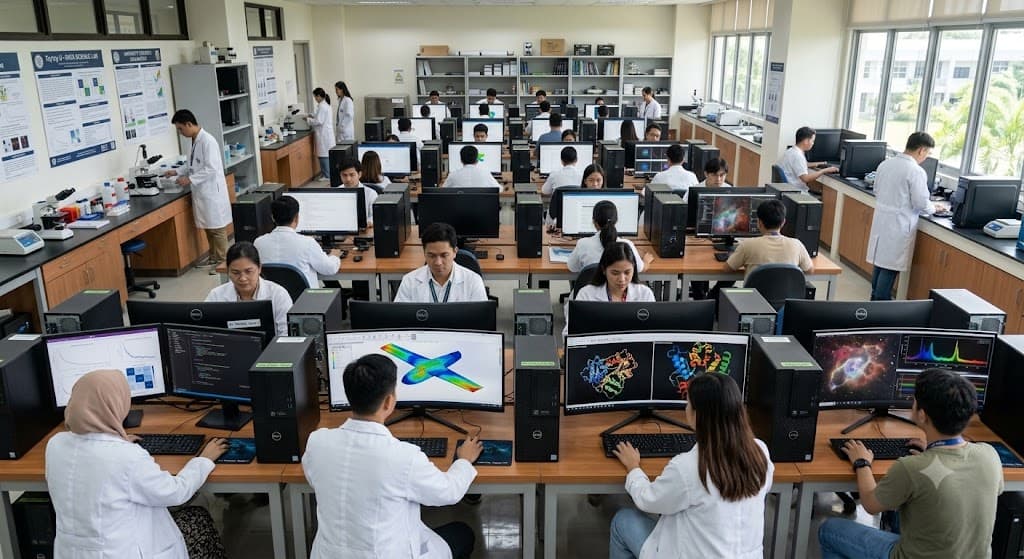
Modern education emphasizes practical learning alongside theoretical knowledge. Affordable GPUs make it possible for students to gain direct experience with technologies that are shaping industries around the world.
Computer science students can learn parallel programming concepts using GPU computing frameworks. Engineering students can perform simulations that demonstrate structural analysis or fluid dynamics. Physics classes can model complex systems, while biology students can analyze large datasets more efficiently. Fields that benefit from GPU-powered educational tools include:
- Computer science
- Engineering
- Physics
- Chemistry
- Biology
- Environmental science
- Mathematics
- Data science
Rather than simply reading about advanced computational techniques, students can interact with real-world applications using hardware that fits within educational budgets.
This hands-on exposure helps prepare graduates for careers where GPU acceleration has become an increasingly valuable skill.
Supporting Artificial Intelligence and Data Science Education
Artificial intelligence and machine learning have become central components of modern science and technology education. Training neural networks, processing large datasets, and developing predictive models often require significant computational resources.
While enterprise-level AI systems may rely on specialized hardware, many educational AI projects run effectively on affordable consumer GPUs.
Students can use these systems to:
- Build image recognition models
- Train natural language processing algorithms
- Explore deep learning techniques
- Analyze large datasets
- Experiment with computer vision
- Develop recommendation systems
Affordable hardware enables universities to establish AI laboratories without requiring massive infrastructure investments.
Instead of limiting GPU resources to a handful of research groups, institutions can provide broader access across classrooms, allowing more students to develop practical experience with emerging technologies.
Improving Scientific Visualization and Research Efficiency
Scientific discovery often depends on the ability to interpret complex information visually. Researchers generate enormous datasets that become much easier to understand when converted into graphs, models, simulations, and interactive visualizations. Affordable GPUs accelerate rendering and visualization across many scientific disciplines with some good examples in:
- Medical imaging
- Molecular modeling
- Geological mapping
- Astronomy visualization
- Weather simulations
- Engineering design
- Geographic information systems (GIS)
Faster visualization allows researchers to identify patterns, test hypotheses, and communicate findings more effectively.
In education, visual demonstrations also improve student understanding. Complex concepts that may seem abstract in textbooks become much clearer when students can observe simulations or manipulate interactive models in real time.
By reducing rendering times and improving graphical responsiveness, affordable GPUs contribute to more engaging learning experiences and more efficient research workflows.
Stretching Educational Budgets without Sacrificing Capability
Educational institutions constantly balance the need for modern technology with financial limitations. Purchasing premium workstation hardware for every classroom is often unrealistic, especially for public schools and smaller universities.
GPUs provide a practical compromise by delivering substantial computational performance at a fraction of the cost of professional-grade accelerators. These graphics cards also offer additional advantages beyond purchase price:
- Lower power consumption
- Easier system upgrades
- Broad software compatibility
- Availability across multiple vendors
- Longer hardware deployment flexibility
Many institutions choose to deploy multiple moderately powered workstations rather than investing in a small number of expensive systems. This approach allows more students to access GPU computing simultaneously, maximizing the educational value of limited budgets.
As software continues to optimize for GPU acceleration, even budget-friendly hardware will remain increasingly capable of supporting advanced educational applications.
Affordable Technology Opens the Door to Bigger Discoveries
As education and science continue to evolve alongside advances in computing, affordable GPUs will play an increasingly important role in expanding access to knowledge, encouraging collaboration, and driving discoveries that benefit society. By making high-performance computing more accessible, these technologies help ensure that innovation is powered not only by cutting-edge ideas but also by practical, cost-effective hardware solutions.